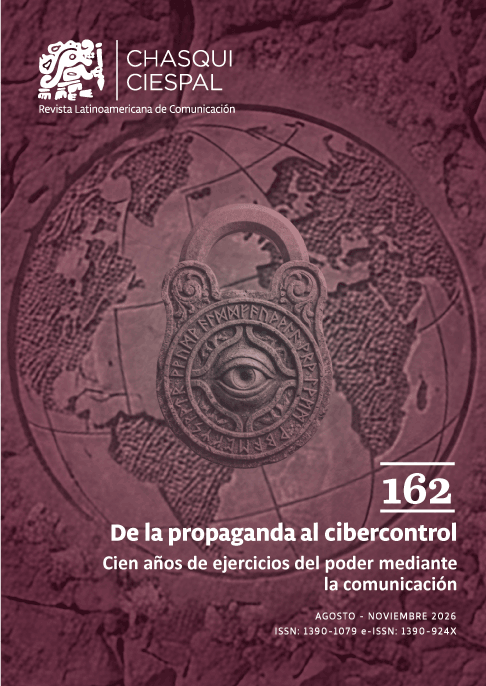
From propaganda to cybercontrol: algorithmic coloniality and educommunication in Latin America
DOI:
https://doi.org/10.16921/chasqui.v1i162.5296Keywords:
digital surveillance, educational platforms, communicational power, decolonial thought, learning analytics, dataficationAbstract
This article traces a conceptual genealogy connecting Lasswell's propaganda model with contemporary algorithmic surveillance practices in education, arguing that algorithmic coloniality reinstates the instrumental logic of communication as control. Through a critical bibliometric cartography of 62 documents (2000-2025) in Scopus, Web of Science, SciELO and Redalyc, the intersection of education, communication and algorithmic power is mapped. Results identify two phases: the consolidation of Latin American dialogic educommunication (2000-2015) and educational platformization with the return of cybercontrol (2016-2025). It concludes that the educommunicative tradition offers theoretical tools for articulating a (re)humanizing communication against algorithmic coloniality in the classroom.
References
Beltrán Salmón, L. R. (2006). La comunicación para el desarrollo en Latinoamérica: Un recuento de medio siglo. Anagramas, 4(8), 53-76.
Castells, M. (2009). Comunicación y poder. Alianza Editorial.
Coeckelbergh, M. (2023). Artificial intelligence in the colonial matrix of power. Philosophy & Technology, 36, 33. https://doi.org/10.1007/s13347-023-00687-8
Couldry, N., & Mejias, U. A. (2019). Data colonialism: Rethinking Big Data's relation to the contemporary subject. Television & New Media, 20(4), 336-343. https://doi.org/10.1177/1527476418796632
Couldry, N., & Mejias, U. A. (2019). The costs of connection: How data is colonizing human life and appropriating it for capitalism. Stanford University Press.
Freire, P. (1973). ¿Extensión o comunicación? La concientización en el medio rural. Siglo XXI Editores.
Fuentes Navarro, R. (1998). La emergencia de un campo académico: Continuidad utópica y estructuración científica de la investigación de la comunicación en México. ITESO/Universidad de Guadalajara.
Fuentes Navarro, R. (2019). Trayectorias sobre el campo en el campo: Meta-investigación académica de la comunicación en México. Comunicación y Sociedad, e7477. https://doi.org/10.32870/cys.v2019i0.7477
Jarke, J., & Macgilchrist, F. (2021). Dashboard stories: How narratives told by predictive analytics reconfigure roles, risk and sociality in education. Big Data & Society, 8(1). https://doi.org/10.1177/20539517211025561
Kaplún, G. (2019). La comunicación alternativa entre lo digital y lo decolonial. Chasqui. Revista Latinoamericana de Comunicación, 141, 75-94. https://doi.org/10.16921/chasqui.v0i141.4077
Kaplún, M. (1998). Una pedagogía de la comunicación. Ediciones de la Torre.
Kwet, M. (2019). Digital colonialism: US empire and the new imperialism in the Global South. Race & Class, 60(4), 2-31. https://doi.org/10.1177/0306396818823172
Lasswell, H. D. (1927). Propaganda technique in the World War. MIT Press.
Lindh, M., & Nolin, J. (2016). Information we collect: Surveillance and privacy in the implementation of Google Apps for Education. European Educational Research Journal, 15(6), 644-663. https://doi.org/10.1177/1474904116654917
Lupton, D., & Williamson, B. (2017). The datafied child: The dataveillance of children and implications for their rights. New Media & Society, 19(5), 780-794. https://doi.org/10.1177/1461444816686328
Macgilchrist, F. (2023). Re-examining AI, automation and datafication in education. Learning, Media and Technology, 48(1), 1-5. https://doi.org/10.1080/17439884.2023.2167830
Martín-Barbero, J. (1987). De los medios a las mediaciones: Comunicación, cultura y hegemonía. Gustavo Gili.
Mattelart, A. (2007). Historia de la sociedad de la información. Paidós.
Milan, S., & Treré, E. (2019). Big Data from the South(s): Beyond data universalism. Television & New Media, 20(4), 319-335. https://doi.org/10.1177/1527476419837739
Noble, S. U. (2018). Algorithms of oppression: How search engines reinforce racism. NYU Press.
Perrotta, C., & Selwyn, N. (2020). Deep learning goes to school: Toward a relational understanding of AI in education. Learning, Media and Technology, 45(3), 251-269. https://doi.org/10.1080/17439884.2020.1686017
Prieto, D. (2017). Construirse para educar. Caminos de la educomunicación. Chasqui. Revista Latinoamericana de Comunicación, 135, 17-32.
Prinsloo, P., & Slade, S. (2015). Student privacy self-management: Implications for learning analytics. Proceedings of the 5th International Conference on Learning Analytics and Knowledge, 83-92. https://doi.org/10.1145/2723576.2723585
Reguillo, R. (2017). Paisajes insurrectos: Jóvenes, redes y revueltas en el otoño civilizatorio. NED Ediciones.
Ricaurte, P. (2019). Data epistemologies, the coloniality of power, and resistance. Television & New Media, 20(4), 350-365. https://doi.org/10.1177/1527476419831640
Romero, C., & Ventura, S. (2020). Educational data mining and learning analytics: An updated survey. WIREs Data Mining and Knowledge Discovery, 10(3), e1355. https://doi.org/10.1002/widm.1355
Selwyn, N. (2014). Distrusting educational technology: Critical questions for changing times. Routledge. https://doi.org/10.4324/9781315886350
Selwyn, N. (2019). Should robots replace teachers? AI and the future of education. Polity Press.
Soares, I. O. (2014). Educomunicação e terceiro entorno: Diálogos com Galimberti, Porto e Lévy. Comunicação & Educação, 19(2), 13-22. https://doi.org/10.11606/issn.2316-9125.v19i2p13-22
Torrico Villanueva, E. R. (2016). Hacia la comunicación decolonial. Universidad Andina Simón Bolívar.
Torrico Villanueva, E. R. (2018). La comunicación en clave latinoamericana. Chasqui. Revista Latinoamericana de Comunicación, 137, 21-36. https://doi.org/10.16921/chasqui.v0i137.3302
Van Dijck, J., Poell, T., & de Waal, M. (2018). The platform society: Public values in a connective world. Oxford University Press.
Varão, R. (2021). Harold Lasswell e o campo da comunicação. Editora CRV. https://doi.org/10.24824/978655578875.4
Williamson, B. (2017). Big data in education: The digital future of learning, policy and practice. SAGE Publications.
Williamson, B., & Hogan, A. (2020). Commercialisation and privatisation in/of education in the context of COVID-19. Education International Research. https://doi.org/10.13140/RG.2.2.21919.00165
Zuboff, S. (2019). The age of surveillance capitalism: The fight for a human future at the new frontier of power. PublicAffairs.
Downloads
Published
How to Cite
Issue
Section
License
Copyright (c) 2026 BRUNO GALASSO

This work is licensed under a Creative Commons Attribution-NoDerivatives 4.0 International License.
- Authors retain copyright and grant the journal right of first publication with the work simultaneously licensed under a Creative Commons Attribution-NoDerivs License (CC BY-ND) that allows others to share the work with an acknowledgement of the work's authorship and initial publication in this journal.
- Authors are able to enter into separate, additional contractual arrangements for the non-exclusive distribution of the journal's published version of the work (e.g., post it to an institutional repository or publish it in a book), with an acknowledgement of its initial publication in this journal.
- Authors are permitted and encouraged to post their work online.