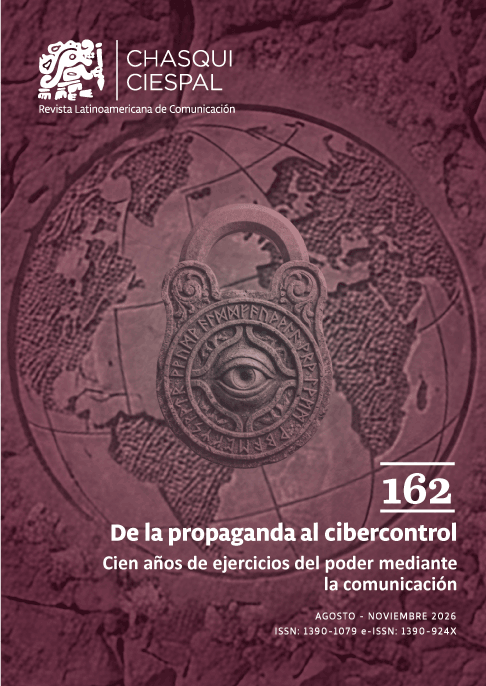
Da propaganda ao cibercontrolo: cem anos de exercício do poder através da comunicação
DOI:
https://doi.org/10.16921/chasqui.v1i162.5386Palavras-chave:
comunicação; meios de comunicação; estudos de comunicação; mediações; comunicação e poder; propaganda; comunicação digitalResumo
Esta edição da convocatória 162 da revista Chasqui apresenta trabalhos que exploram diferentes teorias, metodologias e abordagens analíticas desenvolvidas ao longo de cem anos de pesquisas sobre propaganda e exercício do poder na comunicação, tomando como marco a obra Propaganda Technique in the World War, de Harold Lasswell (1926), considerada pioneira nos estudos sistemáticos sobre o tema.
Referências
Álvarez Rufs, M., Aparici, R., Bordignon, F., & García-Marín, D. (2025). Desinformación y fact-checking en la era de la IA. CIESPAL. https://doi.org/10.16921/ciespal.38.38
Calvino, I. (2023). Por qué leer los clásicos (A. Bernárdez, Trad.). Siruela. (Obra original publicada en 1991).
Castells, M. (1996). La era de la información: Economía, sociedad y cultura. Alianza Editorial.
Castells, M. (2009). Comunicación y poder. Alianza Editorial.
Habermas, J. (1987). Teoría de la acción comunicativa (Vols. 1–2). Taurus.
Habermas, J. (1989). The structural transformation of the public sphere: An inquiry into a category of bourgeois society (T. Burger, Trad.). MIT Press. (Obra original publicada en 1962).
Katz, E., & Lazarsfeld, P. F. (1955). Personal influence: The part played by people in the flow of mass communications. Free Press.
Lasswell, H. D. (1927). Propaganda technique in the world war. Alfred A. Knopf.
Martín-Barbero, J. (1987). De los medios a las mediaciones: Comunicación, cultura y hegemonía. Gustavo Gili.
Mattelart, A. (2009). Un mundo vigilado. Paidós.
Mills, C. W. (1957). La élite del poder. Fondo de Cultura Económica. (Obra original publicada en 1956).
Downloads
Publicado
Como Citar
Edição
Seção
Licença
Copyright (c) 2026 Erick TORRICO, Raúl FUENTES NAVARRO, Rafiza VARÃO

Este trabalho está licenciado sob uma licença Creative Commons Attribution-NoDerivatives 4.0 International License.
- Los autores/as conservarán plenos derechos de autor sobre su obra y garantizarán a la revista el derecho de primera publicación, el cuál estará simultáneamente sujeto a la Licencia Reconocimiento-SinObraDerivada de Creative Commons (CC BY-ND), que permite a terceros la redistribución, comercial y no comercial, siempre y cuando la obra no se modifique y se transmita en su totalidad, reconociendo su autoría.
- Los autores/as podrán adoptar otros acuerdos de licencia no exclusiva de distribución de la versión de la obra publicada (p. ej.: depositarla en un archivo telemático institucional o publicarla en un volumen monográfico) siempre que se indique la publicación inicial en esta revista.
- Se permite y recomienda a los autores/as difundir su obra a través de Internet.