Mapear para defender la vida: Investigación-Acción Participativa, tecnologías abiertas y cartografía comunitaria en la región andino-amazónica: el caso Wairari Atun Sacha (Santa Rosa, Sur del Cauca)
DOI:
https://doi.org/10.16921/chasqui.v1i161.5279Palabras clave:
Pan-amazonia, Investigación Acción Participativa, Tecnologías abiertas, Cartografía participativa, Comunicación comunitaria, Gobernanza indígenaResumen
Este artículo analiza el proceso de cartografía participativa desarrollado con el Cabildo indígena Wairari Atun Sacha, en el sur del Cauca, como una experiencia de Investigación-Acción Participativa (IAP) que articula saberes comunitarios y tecnologías abiertas para la producción de datos territoriales en contextos pan-amazónicos en tensión. Se examina cómo el uso de plataformas abiertas de cartografía, monitoreo comunitario y registro geoespacial fortalece la comunicación comunitaria, la gobernanza indígena y la defensa del territorio frente a disputas extractivas y urbanas. El estudio demuestra que la combinación IAP–tecnologías no solo genera información, sino que también reconfigura las relaciones de poder, las narrativas territoriales y las estrategias locales de sostenibilidad.
Webinar 4 - Chasqui 161
Urbanización residual y cartografías comunitarias
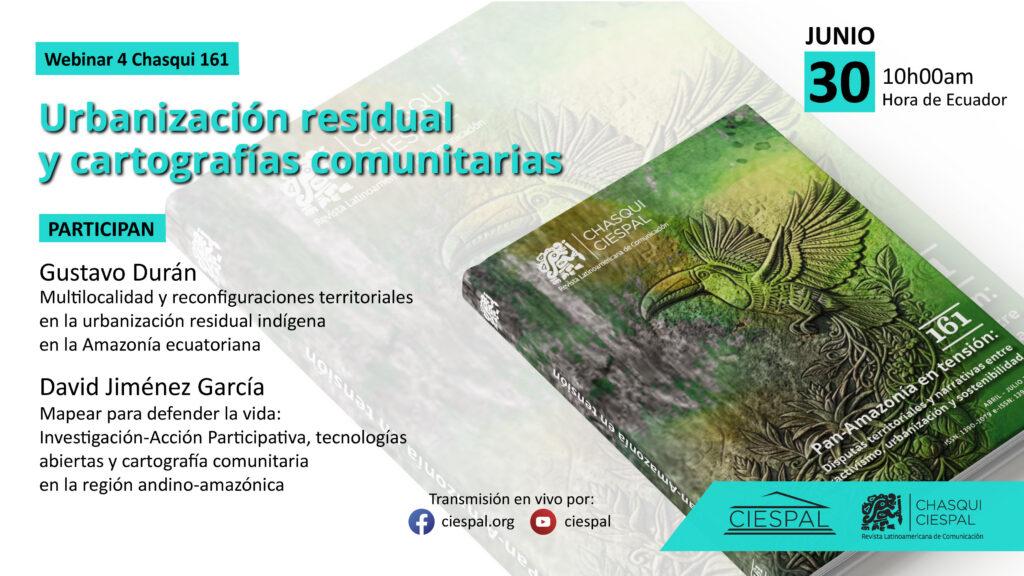
Te invitamos a mirar la presentación de David Jiménez García

Citas
Acosta, A. (2010). El Buen Vivir en el camino del post-desarrollo. Una lectura desde la Constitución de Montecristi. Policy Paper 9, Friedrich Ebert Stiftung. Quito: FES-ILDIS.
Acosta, A., & Martínez, E. (2009). El Buen Vivir: una vía para el desarrollo. Quito: Abya-Yala.
Breda, T. V. (2022). (Of) Indigenous Maps in the Amazon: For a Decolonial Cartography. ISPRS International Journal of Geo-Information, 11(3), 161. https://doi.org/10.3390/ijgi11030161
Bryan, J. (2011). Walking the line: Participatory mapping, indigenous rights, and neoliberalism. Geoforum, 42(1), 40-50.
Córdoba, D., & González, Y. (2016). Cartografía participativa en la planificación local: experiencias de construcción de conocimiento espacial comunitario. Revista XYZ, 12(3), 55-70.
Escobar, A. (2003). Mundos y conocimientos de otro modo: el programa de investigación modernidad/colonialidad latinoamericano. Tabula Rasa, 1, 51-86.
Escobar, A. (2012). Una minga para el postdesarrollo: lugar, medio ambiente y movimientos sociales. Lima: Universidad Nacional Mayor de San Marcos / Instituto de Estudios Peruanos.
Escobar, A. (2018). Autonomía y diseño. La realización de lo comunal. Bogotá: Editorial Universidad del Cauca.
Fals Borda, O. (1997). El problema de cómo investigar la realidad para transformarla (7.ª ed.). Bogotá: Tercer Mundo Editores.
(February 6, 2025). Recorrido ambiental en el Norte del Cauca – 7 de febrero de 2025. Consejo Regional Indígena del Cauca (CRIC). https://www.cric-colombia.org/portal/informativo-red-amcic-cric-recorrido-ambiental-en-el-norte-del-cauca/
Freire, P. (1993). Pedagogía de la esperanza: un reencuentro con la pedagogía del oprimido. México: Siglo XXI.
García, D. L. (March 31, 2025). Participatory Mapping for a Sustainable Amazonia. IAI - Inter-American Institute for Global Change Research. https://www.iai.int/en/post/detail/TF020-IAI
Gudynas, E. (2011a). Más allá del nuevo extractivismo: transiciones sostenibles y alternativas al desarrollo. En A. Acosta & E. Gudynas (Eds.), Alternativas al desarrollo: críticas y propuestas desde América Latina (pp. 187-225). Quito: CAAP/CLAES.
Gudynas, E. (2011b). Redefiniendo el progreso: los dilemas del desarrollo bajo el extractivismo. Montevideo: Centro Latinoamericano de Ecología Social (CLAES).
Jiménez García, L. (2025, septiembre). Defending territory with tradition and technology in Colombia. D+C Development and Cooperation, edición 09/2025, 48-50. (Artículo de revista de divulgación).
Jiménez García, L. (2025a). Informe de Trabajo de Campo – Cauca: Proyecto “Mapeos participativos para una Amazonía Sostenible”. Medellín: UNAULA – Centro POMOTE / Humanitarian OpenStreetMap Team (HOT). [Informe inédito].
Jiménez García, L. (2025b). Cartografía en movimiento: experiencias de mapeo participativo para la gestión del riesgo y la justicia territorial. Medellín: UNAULA-Centro POMOTE & HOT – LAC Hub.
Jiménez García, L., & Garcés Montoya, Á. (Eds.). (2024). Cartografía social: minga de saberes y metodologías. Medellín/Ibagué: UNAULA – Ed. Unibagué.
(June 30, 2024). Mapeos participativos para una Amazonía sostenible: tecnología y saberes para defender el territorio. Humanitarian OpenStreetMap Team. https://www.hotosm.org/updates/mapeos-participativos-para-una-amazonia-sostenible-tecnologia-y-saberes-para-defender-el-territorio/
Kothari, A., Salleh, A., Escobar, A., Demaria, F., & Acosta, A. (Eds.). (2019). Pluriverse: A Post-Development Dictionary. New Delhi: Tulika Books.
Rodríguez, I., & Büscher, B. (2018). The politics and epistemologies of data‐driven conservation. Political Geography, 65, 1-4.
Svampa, M. (2019). Las fronteras del neoextractivismo en América Latina: conflictos socioambientales, giro ecoterritorial y nuevas dependencias. Revista de Ciencias Sociales (UAM), 25(Extraordinario), 17-42.
Team, H. O. (June 30, 2025). Mapeos participativos para una Amazonía sostenible: tecnología y saberes para defender el territorio. ([hotosm.org](https://www.hotosm.org/updates/mapeos-participativos-para-una-amazonia-sostenible-tecnologia-y-saberes-para-defender-el-territorio/?utm_source=openai)). https://www.hotosm.org/updates/mapeos-participativos-para-una-amazonia-sostenible-tecnologia-y-saberes-para-defender-el-territorio/
Valdivia, J. A. & Marín, M. (June 12, 2025). Mapeos participativos para una Amazonía sostenible: tecnología y saberes para defender el territorio. Humanitarian OpenStreetMap Team. https://www.hotosm.org/updates/mapeos-participativos-para-una-amazonia-sostenible-tecnologia-y-saberes-para-defender-el-territorio/
Zambrano, M., & Urteaga, P. (2019). Participatory mapping and environmental conflict resolution in the Amazon: The case of the Wachiperi. Journal of Latin American Geography, 18(3), 221-247.
Descargas
Publicado
Cómo citar
Número
Sección
Licencia
Derechos de autor 2026 David Jiménez Garcia

Esta obra está bajo una licencia internacional Creative Commons Atribución-SinDerivadas 4.0.
- Los autores/as conservarán plenos derechos de autor sobre su obra y garantizarán a la revista el derecho de primera publicación, el cuál estará simultáneamente sujeto a la Licencia Reconocimiento-SinObraDerivada de Creative Commons (CC BY-ND), que permite a terceros la redistribución, comercial y no comercial, siempre y cuando la obra no se modifique y se transmita en su totalidad, reconociendo su autoría.
- Los autores/as podrán adoptar otros acuerdos de licencia no exclusiva de distribución de la versión de la obra publicada (p. ej.: depositarla en un archivo telemático institucional o publicarla en un volumen monográfico) siempre que se indique la publicación inicial en esta revista.
- Se permite y recomienda a los autores/as difundir su obra a través de Internet.